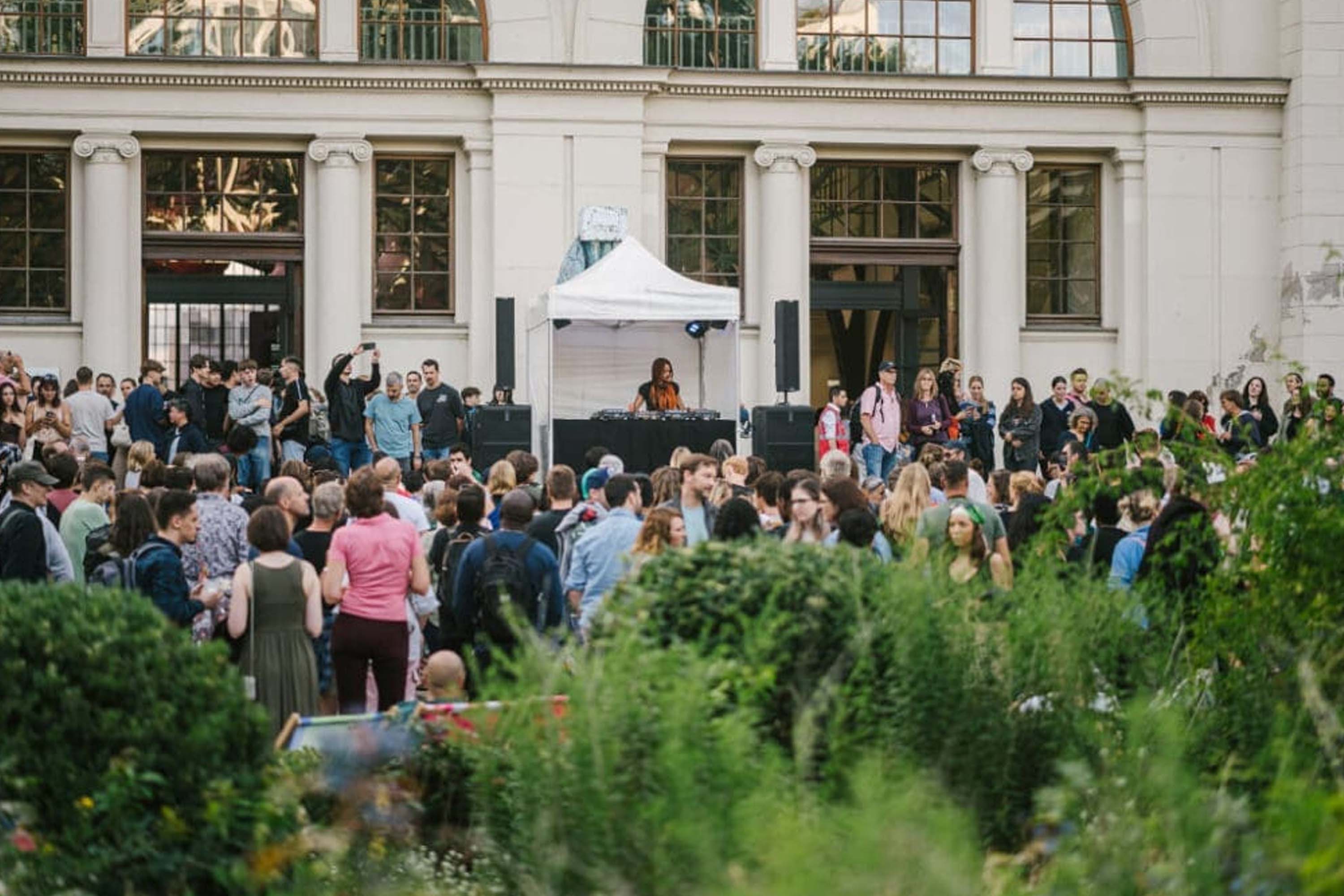
18 August 2026 | Photo: Alex Rentsch, Berlin Beats at Hamburger Bahnhof, 2023
Art institutions are increasingly turning to DJs as artists, curators and audience builders, as highlighted in a new piece by Sofia Hallström for Art Basel
Art institutions are increasingly making room for DJs. From Hamburger Bahnhof and Neue Nationalgalerie in Berlin to MoMA PS1 in New York and Tate in London, club culture is moving deeper into the institutional art world.
In a recent article for Art Basel, writer Sofia Hallström traces the relationship between art and club culture back more than a century, from Dada’s Cabaret Voltaire and Andy Warhol’s Exploding Plastic Inevitable to the warehouses, raves and sound-system cultures that shaped contemporary nightlife.
For artist Mark Leckey, who has spent much of his practice connecting the worlds of art and rave culture, part of the shift is generational. “I remember going to art school and no one could dance,” he tells Hallström. “There’s a different demographic in the art world now,” he says. “More connected to clubbing and that whole culture.”
The DJ’s growing institutional status also reflects a changing understanding of what the role actually involves. Rather than simply providing a soundtrack, DJs curate environments in real time, reading a room and connecting different histories, sounds and audiences. South London poet and DJ James Massiah describes it as ‘good curation’, arguing that both DJs and art curators create contexts that allow audiences to reach their own conclusions. Reflecting on the crossover itself, Massiah adds: “Most of my experiences of the art world and club world crossover have been eye-opening, decent, and wonderful.”
Oda Haliti represents the reverse trajectory, moving from rave culture into institutional art spaces. After 15 years in the Balkan club scene, where she ran her own bar and booked nights in Kosovo, her practice has since entered contexts including Hamburger Bahnhof’s Berlin Beats series and the Lyon Biennale. But Haliti rejects the idea of crossing from one world into another: “I don’t necessarily see myself as entering the art world. I think I’m bringing a practice that has always existed between different spaces.”
There is also a practical reason behind the crossover. As arts funding comes under pressure and clubs continue to close across major cultural centres, institutions can offer DJs resources, audiences and spaces at a time when independent nightlife is increasingly vulnerable.
“Both the art world and the music world are alienating in their own ways – through gallery closures and market pressures in art, and through streaming and Spotification dissolving potential income in music,” Leckey tells Hallström. “There’s an economic drive behind [the art-music crossover], but also a recognition between the two that offers a space with real potential.”
For Hallström, the current DJ-booth boom is therefore less a sudden collision between two previously separate worlds than another chapter in a much longer exchange. What is changing is not the relationship itself, but the extent to which institutions are now willing to recognise DJing as an artistic and curatorial practice in its own right.